


This is a potted history of Denmark Farm
These are the stories we have been able to piece together so far..
If you have any other information or photographs relating to Denmark Farm, we’d love to hear from you.

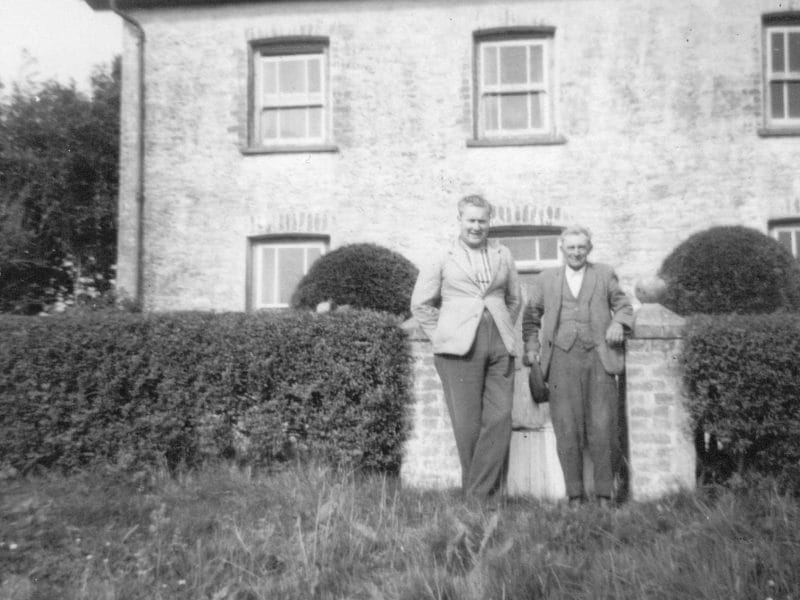
200 years ago…
The farm was founded sometime between 1799 and 1819 by John Jones, a local Welshman. Mr Jones lived in London at the time, on or near Denmark Hill (which still exists today).
We think that, having made his ‘fortune’ in England, Mr Jones returned to his beloved homeland to start a farm. Locals refer to it simply as ‘Denmark’.
As far as we know – and unusually for this area – Denmark Farm has never had a Welsh name.
150 years ago…
Dai Jones (Cambrian Printers, Aberystwyth) recalled a little stanza about an incident which took place at Denmark Farm around 150 years ago. It was written by a poet from the Jenkins family in Tregaron, who is believed to be an uncle of the well known Swagman, Joseph Jenkins, Tyndomen, Tregaron.
Here it is as Dai was told many years ago by his father…
The worst man God ever made
Yn Denmarc Farm mae Spill yn byw
A’r gwaethaf dyn a greodd Duw,
Aeth un o’r da i gae yr yd
A thyngodd y diawl fod nhw yno i gyd.
Roughly translated as…
At Denmarc Farm, Spill lives
And the worst man God ever made,
One of the good went to the wheat field
And the devil whispered that they were all there.
100 years ago…
Vanessa told us that her grandparents farmed at Denmark Farm, Betts Bledrws in the mid 1920’s to early 30’s.
They were Edward & Annie Williams and they moved from to Lampeter from Harlech, and then returned to farm at Penrallt near Harlech in 1933. Sadly they have all now died but I remember my father talking about the move to Denmark Farm…
“They had been delayed for some reason but when they arrived, neighbouring farmers had already ploughed the land & planted (what they planted, I don’t know) realising that it was too late in the year to start planting after they arrived.”
My father had been very impressed by their kindness.

1930s
We have also heard from Elunud Kemp who is the niece of Tom and Hilda Davies who lived and farmed here between 1933 and 1967. Elunud said:
“I can recall pigs, beef, dairy, and some sheep, a lot of free range hens, large veg patches, cabbage fields, great mushrooms in one field, and hazels on the lane, a pump for the well to get water, and what can best be described as a latrine, no indoor sanitation.
Uncle Tom and Aunt Hilda both died childless within rapid succession of each other. I spent all my school holidays at Denmark Farm as a child and it is a huge part of who I am. I have such fond memories of it. I have it preserved in aspic in my mind.”


Denmark Farm… A wildlife haven?
Our modern history began in 1984 when Barbara and Neil Taylor bought Denmark Farm and suffered deep disappointment at finding no blackberries and hearing no birdsong.
Like many others, Denmark Farm had been progressively intensified and its rye grass fields and bare hedges were typical of vast areas of grazing land.
A soil expert told them they should poison the moles which were damaging the grass and yet Barbara found herself replying ‘No, we couldn’t do that; it’s their farm as well as ours. They were here before us and they’ve got to make a living too’.
That thought grew into a conviction that the land – the Earth – is shared and so they began a programme of reversing the destruction of wildlife habitat which had taken place.


The birth of the Shared Earth Trust in 1987…
In 1987 the Shared Earth Trust was specifically set up to establish and run a long-term conservation project at Denmark Farm as a ‘haven for wildlife’.
The Trust’s aim was to see whether this process of degradation could be reversed without major inputs or capital expense and then to monitor the speed and extent of the return of wildlife.
Our founding Trustees were Doctors Anthony and Maggie Barker and during the first four years, the work developed almost entirely through volunteers like them who often gave time and money in support.

A vision
Our vision was to bring back the common species which ought to be found on any piece of farmed Welsh countryside – blackbirds, robins, bluebells, primroses, small tortoiseshell and common blue butterflies, so things had to change…
Uniquely, a more traditional grazing system was implemented using cattle rather than sheep, and we began haymaking, blocked field drains, stopped most fertiliser input and fenced off overgrazed hedgerows, streams and ditches to help ‘kickstart’ natural processes.
The results were spectacular!
In 1985 only 15 species of bird bred on the farm but by 1994 this had risen to 48 species.
This was a pioneering case-study in what could be done anywhere; turning a ‘green desert’ into living countryside.
In 1993, tragically the Barkers were knocked off their tandem and killed, but two years later the Barker Memorial Centre was opened.
Then in 1997 the Trust took over ownership of the farm and work began on converting existing out-buildings into an education centre and dormitory.
One purpose of Denmark Farm was to establish a better relationship between food production and biological diversity; moreover conservation and ‘making a living’ have to go hand in hand.
The vision was that all farms might have a ‘little bit of Denmark Farm’ somewhere on their land, yet this was an idea well ahead of its time.
Through all of this there has always been a profound respect for wildlife and an awareness of a spiritual dimension – human beings are part of the natural world, completely interlinked with and interdependent on nature.
And that striving for real health – physical, mental and spiritual – still underpins all that we do.

Today…
Today Denmark Farm Conservation Centre is still the physical home of the Shared Earth Trust. The results of the rewilding project continue to deliver amazing outcomes…
The results have been astonishing:
- we see an average of 46 species of birds breeding on the land every year;
- fields once dominated by rye grass are now rich in flowers, grasses and sedges, with the most diverse meadow containing over 100 species;
- the lake and ponds now support 14 species of breeding dragonfly and damselfly – an impressive diversity for west Wales;
- large populations of small mammals, butterflies and ground invertebrates have returned to the meadows and pastures, including our latest discovery – water voles.
The Barker Memorial Centre now takes pride of place as our head office and shop, while the outbuildings are being well used as training venues for our popular rural skills and heritage crafts workshops, and as a base for our conservation and gardening volunteers to work from.

Building for the future
Our Ecolodge was built in 2013, to the highest ecological standards at the time and today welcomes families, large groups of up to 14 and workshop participants for accommodation on site.
It’s an eco-friendly holiday destination in the heart of the 40 acre-nature reserve at Denmark Farm.
Find out more about Denmark Farm….


